People always ask why I don’t eat meat and it’s not really because of animal cruelty, it’s more about were it comes from and how detached I am from it. This slow design idea I believe is in the same frame of thinking. We as a culture of consumers only think about the transfer of a product to the store in to our possession and after that as long as it doesn’t break or go out of style we don’t really think about it. The designed objects talked about in the Slow Design Principles really push the user of the object to think about what the object does for them and where the materials came to make it. I can just hear some of the disgusted responses by some people who might have seen the lamps made from lamb stomachs and then went home to sit on their leather coaches and eat their animal products that no longer look anything like the animal they came from without even cringing. I don’t care if someone eat steak or has a whole furniture set made of leather just realize it came from an animal that ate up and used resources it self to produce you something. I think if people did this more often people would waste less and try to care of what they had instead of replacing blindly.
Tuesday, February 2, 2010


Autonomous Lifestyle
Claire Pentecost also talks about this in "Autonomy, Participation, And"
We notice that the “auto” in autonomy starts to resonate with the auto, that all too precise symbol of individual freedom that appears indispensable to a life of agency in America. The auto that creates tedious traffic jams, respiratory diseases, wars, and deformed environments and, as long as we have one, saves us the inconvenience of coordinating our needs and desires with a larger populace. The lubricant of individual freedom so complicit in the erosion of community and social encounter that symbolic micro-gestures of participation are meant to salve.So I think that a lot of technology and gizmos also give us those illusion of control over our lives - that having constant access makes us smarter, more productive, etc. They don't necessarily, especially if we allow them to run our lives. On the balance, I'm sure one day I'll get a cel phone. But for the moment, I'm planning my next technology move - rain barrels recycled from factory equipment.
Joe Pankowksi Reading Response 3
The Bratton and Jeremijenko conversation discusses the information used to solve large problems like global warming and air pollution. The information found by either academics or government organizations is most of the time absorbed by our society without much questioning. What is being offered in this discussion is that there should be some kind of movement to allow the general population to find and take in their own data about the environment so they compare their own personal data and relationship with their localized environment, to the large-scale findings of institutionalized data.
The idea of using the model of a health clinic for environmental purposes is a pretty original idea that I thought made since. Placing environmentalism in the same category as social programming keeps the problem at a level which people can get their heads around. I wonder though how such an unfamiliar idea even though formulated after a health clinic would be taken seriously by the local community unless they knew such action would make them healthier and economically better off. I don’t think that they get into how they will educate the public why such an idea is a good one and why they should use a service like an Environmental Health Clinic. The public is use to listening to those government agencies and academics on why they should be doing and what to worry about.
Slow Design Principals & Autonomy, Participation, And: Response 4
The Slow designed Principles are described as a “new interrogative and reflexive tool for design and research practice that offer an opportunity to find fresh qualities in design research, ideation, process and outcomes.” Most importantly Slow Design is a unique and vital form of creative activism that is delivering new values for design and contributing to the shift toward sustainability. The Slow Design Principals include: revealing, expanding, reflection, engagement, participation, and evolution. This text, though it provides a certain framework that suggests that by following these ‘steps’ a project will be successful, in my opinion has the potential to choke off other opportunities a work may present. However, after rereading the text, I couldn’t help but think of other examples that I felt fit in to the Strauss and Fraud-Luke’s design strategies. As students I think that is wise to take in to consideration principles such as those presented within the text. They are open enough to be applied to any project as strictly or broadly as desired by the maker. Below are two projects that I thought were other examples of how these principles could/were applied to contribute towards the “shift toward sustainability.”
Pig 05049 by Christien Meindertsma


Farm Fountain by Youngs and Rinaldo

A quick response to the Autonomy, Participation, And text by Clair Pentecost:
I found this text to be incredibly enlightening and valuable to read within the context of this course. As a student it found it interesting to read her notion of how we must produce work that becomes condensed to fit within the gallery setting to be ‘accepted’ and even then, depending on the type of work, it must jump through several sets of hoops to be shown, the more prestigious the gallery, the more hoops to jump through. Though I am guessing my thoughts have strayed from the points of the article I found it interesting to read these two selections together. Though they both touch on many similar notions, I can’t help but think that the Slow Design Principles are trying to set up a framework to aid in work production where as Pentecost’s text, though encourages and gives several examples of successful works, in the beginning points to the lack of freedoms in making art. Pentecost says “We will accept the rules because we will have worked so hard to get there, and because in every way we are starved for validation” not necessarily discourages art practice, but does highlight the problems one will face regardless of whether they follow design principals or not.
Response 4, Slow Design - Julio
I consider the guiding principles they present to be open enough to allow them to be applied to a very broad set of fields (all design related fields too, of course), and this is clearly seen by the range of examples they present. Personally, I have to say that the idea that really captivated me was “[…] slowing the metabolism of people, resources and flows”. I just think the societies of developed countries need this idea, but not only applied to design, but to every single field.
Nevertheless, regardless of my personal inclination to the idea of slowing our metabolisms (through revealing, expanding, reflecting…etc), I found the description of the workshop that Fuad-Luke run to be quite less deep into the matter than it should. Maybe it is just a matter of the short description of the workshop that is presented, but from my perspective, it looks like a methodology to create collaborative designs. That is to say, even though it is an interesting methodology, it does not go as far as the Slow Design principles state. Collaborative design is not a groundbreaking idea (and its not their only point), so I believe the workshops they create to introduce the Slow Design principles should go a little bit further in how they change the methodology of design (which I found very interesting an potentially positive).
Slow Design Response
Buddhist monks meditate while the take slow steps across an enclosed space in circles. I look at these designers like monks with a purpose, trying to realize their place in the world through their designs. They communicate with nature just as spirit seekers do and get to a place where time slows down, the heart rate is magically relaxed, the blood flow is fresh and nervousness and anxiety is unheard of. There is a facebook note I found that echoes my opinion of how Slow Design is something that must have come out of Zen meditation and stuff like that.
http://www.facebook.com/note.php?note_id=151265669208
Response 3, Situated Advocacy - Julio
I have to say tough, that regardless of the relevance of the topics they discuss, I found some aspects of the text quite superficial and unjustified. When they for instance criticize the spectacularization of information I feel they just leave their opinion there without a sound series of examples to get a little bit deeper into the matter. I think “The Environmental Health Clinic” and other initiatives they describe are relevant enough by their own without the need to criticize other practices (specially when I didn’t find consistent examples in the text). Of course the ideas of co-production of knowledge, one-to-one talk, participation, or locality that they present, pose interesting directions to work on.
One of the main points they make, in my view, is the idea of locality as a necessary ingredient for people to get involved. I think its pretty clear that the “natural” selfishness of human beings make it quite difficult for us to act upon something, unless we see a clear connection to our daily lives. In relation to this idea (and also to complement the great image posted by JD), I would like to post Eliasson’s project Green River, which places the attention on the very matter that surrounds us, as a way to increase our awareness in our environment (in a visually striking manner).

Situated Advocacy: Reading Response 3
The Situated Technologies Pamphlet series concentrates on the exploration of the “implications of ubiquitous computing for architecture and urbanism. Specifically this series addresses how our experience of space and the choices we make within are affect by the range of mobile, persuasive, embedded, or otherwise situated technologies.” Within this text Bratton and Jeremijenko discuss self-advocacy, environmental protection, and various human rights and social injustices. To address these issues both Bratton and Jeremijenko take a close look at the value of data collection and the importance of its purpose and more importantly how those doing the collecting sway its importance and presentation.
In regard to data collection, they present us with many examples of devices that utilize different types of sensors to detect non-human organisms to provide important information about their conditions. Thus allowing a new form of data collection and ultimately an important, useful, and informed method for activating data to spark change and awareness.
I was specifically interested in the “Death of the User” section of the text (pgs. 51-53). Specific to my work/ideas and that of many other current artists, how we structure non-human agency poses a great opportunity to integrate non-humans at the instigation point of distributed interactions where the otherwise human user would be. By biodiversifying who is represented in agricultural, urban, and suburban contexts humans pay closer attention to those with which we cohabitate. More importantly by investigating data found from works that sense non-humans we can “reconsider structures of ownership, including private property and how it extends to these non-human agents in the environmental commons”.
Though I agree with much of what Jeremijenko discusses in this section and feel that she is calling attention to very important ideas, I do not agree that the user, in Bratton’s terms, has “died”. Rather, I feel that the user has simply changed from human to non-human. Though many would argue that non-human organisms cannot be users because they do not comprehend their actions, there are many accounts where data of human behavior is being collected and they too are not aware that they have the ability to manipulate data (i.e. using hidden cameras and infrared sensors to track a particular event in any project).
Ultimately what is important that through these non-human sensing works, we can begin to recognize a “non-human-centric world” and can begin to see to see a non-human point of view that would allow us to act upon our surroundings and provide better solutions for our environment issues.

Feral geese, like other populations of urban animals are either disdained, hunted, or at best ignored. They are not the 'wildlife' that environmentalists heroically seek to protect, and yet their survival testifies to a functioning urban ecosystem - they have critical functional, remediative and arguably redemptive roles to play in an urban ecosystems that are poorly understood. They are the most hopeful of environmental agents precisely because they demonstrate adaptive strategies that we have not observed before, and do not understand. There is a great deal to learn from them. Moreover, they demonstrate that we and our urban environment are inside nature, not separate or distinct from it. When animals make autonomous choices to inhabit places that we do not recognize as 'natural' they teach us that we live in something natural.
OOZ takes the urban animal habitats that animals themselves have initiated as its starting point. These contexts provide an opportunity to learn what the resources and structures animals themselves have exploited by directing our attention to the architectural and adaptive innovations these nonhumans have made
Monday, February 1, 2010
Reading Response 3 | Situated Advocacy | JD Pirtle
They provide some interesting examples of sensing structures in which non-human entities become aggregate political groups, e.g. co2 sensors on trees. Also, the portions of the text in which they discuss the role of the artist as an additional individual engaging science as "model citizen and naive scientist.” This is similar to artists like Vibeke Sorensen working alongside scientists at the San Diego Supercomputer Center in the capacity as peer, as early as the 1970s. They valued the perspective that Sorensen brought to any project she worked on, perspectives that were outside of rigid scientific method and therefore fostered innovation. Jeremijenko and Bratton make the excellent point that perhaps artists are the only beings that could take the vast clouds of data and create an “image” that has some sort of cultural/environmental/emoitional currency beyond merely a sexy data visualization.
I think Jeremijenko’s How Stuff Is Made project provides the provenance of manufactured objects in a way that is very accessible. Rather than the common extremes of showing the cost/benefit of our culture through either consumable media coverage or white paper dissection, How Stuff Is Made democratizes the contemplation of where our stuff comes from.
I thought many times throughout this text about various efforts of artists recently present a non-data based image of environmental impact--for example, many of Burtynsky’s photos.

Situated Advocacy - Response - Arunan
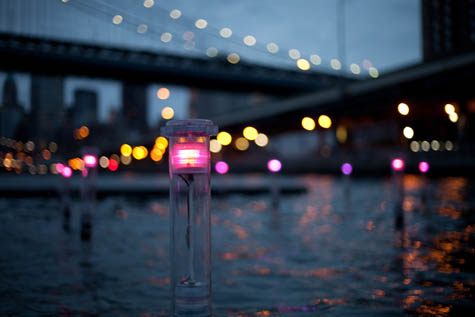
Fish Sensor from xDesign Project on Vimeo.
But, still I could see some evidence of helping an ecosystem by creating interventions in their work. For example the fish display thingy in the Hudson river which responds to fish movement and also enhances people interactivity by having them feed the fishes with food that apparently removes bad stuff from them. I also thought such interventions might some time negate the positiveness they promulgate when people start throwing in lays chips wrappers, hot-dog packages and other crumbs of waste stuff into the river and start polluting it themselves.
Sunday, January 31, 2010
Reading Response - Reading 1&2 Week 3
On the other hand, it is well known that Nike employees people in third worlds countries, pays them $0.001 a day and sells its products with %400 of profit. The fact that the public is aware of this situation didn't seemed to change neither Nike's profits nor the its methodologies. Who do we blame for this? Maybe the designers how made such nice shoes, or us for keep buying them, or the governments for not prohibiting Nike to commercialize its products.
Let us consider the designers for a moment, in the Slow Design reading we meet Julia Lohmann, a designer how "believes that acknowledging the origins of a product is the first step towards making more informed and ethical choices about what we consume." What does Julia designs taking into account this premise? Lamps made out of cow stomachs:

I find the lamp pretty gorgeous, I know that is a cow's stomach and I still want one, even more, because is a cow's stomach I want one!!!! By having this lamp I will be more empathetic towards the cruelty inflected to the cow's, by having this lamp I'll be a responsible consumer. I wonder how much it will costs me to buy 100 lamps, we will need 100 cows.
It seems to me that being a responsible consumer has turned out to be another good strategy for selling. Examples of this phenomenon can be found everywhere: "if you buy this water, you will be contributing to starvation" To buy is to change the world.
Wednesday, January 27, 2010
Joe Pankowski, Assignment1
I chose activity number four, Research and Debate from the Yes Men’s Teaching and Action Guide. The part that struck me the most about this activity was the question; who pays the price for those cheap goods we take for granted? I also wanted to touch upon the ridiculous things people think they need at unrealistic low prices. I decided to change the activity a little, and to make a video piece that would invoke debate about our consumption of absurd products at a high cost to our environment and humanity. The video piece is a mash-up of an old 1950’s propaganda film about capitalism and why it’s so important for our way of life. I inserted in this film what makes our capitalistic system function today, in order to make things such as lower costs for competition purposes possible. I also tried to find the most absurd product I could find that no one would ever need, but some might think they need. The product I chose was an MP-3 playing toilet paper dispenser. I imagine the people making these things for the American market must think we’re the biggest idiots. The tag line for this little number was as follows; “Now you can Enhance your Experience in any room with your favorite music from your iPod.” And the price was even better at only $29.99 with free shipping. Amazing! I hope the video will make people think twice about what they really need to live their lives, while also causing them to think about their impact on others and the world in which live in.
Project One | JD Pirtle
The TV spot features many generic techniques that are very popular with modern ad agencies--time-lapse shots of nature, personal sentiment (between a corporate entity and the viewer), still image transforms (so-called “Ken Burns Effect”) and the use of famous Opera arias that are present in poor or inaccurate context.
The inspiration for the subject matter is directly related to the disgust I felt when I was able to reflect on how poorly the Federal Government handled Katrina relief, how FEMA mismanaged resources and “lost” billions of dollars and how the disparity in natural disaster relief seems to point to bigoted ideology in the Federal Government. In hindsight, it is apparent that the funds and resources were present, but the government would not or could not help the people affected by Katrina. With this project I wanted to both show what could have been and what should have been--that a strong, centralized government in the form of a Republic should be able to quickly and effectively respond to these types of situations using funds taken those that are affected via taxes, etc.
View FEMA "Duets"
Project 1, Suspicious Ambivalence, Obelleiro-Borsani
Link here: Suspicious Ambivalence
Project 1
After working as a photojournalist for 4 years for a paper that reached nearly 35,000 people on a daily basis, my love for the newspaper and all news media died. Off assignment, I would spend hours sitting by a police scanner, waiting for a deadly car accident, a house fire, a business robbery, anything that would constitute for an ‘exciting’ news feature. If a day went by without some kind of tragedy, it was slow and the supplemental photographs taken to fill in the feature news spots were usually seen by the editors as less exciting than those depicting what I could only think of as calamity. Nonetheless I thrived on the stories that were dangerous, and apparently so did the public. With every day and every story that had some sort of negative note, following a murder trial, covering crooked politics, and going trigger-happy over deathly incidents, I found myself becoming uncomfortably desensitized to emotion. While I did cover my fair share of “happier” news features, county fairs, concerts, local charity events, the stories that I always heard people talk about were those of a ruinous nature. No one ever really remembers or cares about the kid who raised 20,000 dollars for a charity event helping autistic children when people died in a shoot out down the street. Unfortunately it seems like we thrive on tragedy and useless celebrity gossip.
Though many complain about the negative nature of the news and throw out the old saying “no news is good news,” these same people are often the ones who still purchase or support in some form (via the internet) their local newspapers. This readership, though riddled with complaints, is what keeps these stories alive and splashed across the front page of every section. Though some of it is viable news, and there are a few quaint stories of hope, the majority of the news, be it on TV, the Internet, or in the newspaper is rarely indicative of anything good going on in our world.
Following the Yes Men Fix The World Teaching guide, I will be completing a variation of the News Paper Activity. My action plan is to re-appropriate 3 stories from both the Chicago Sun-Times and the Chicago Tribune so that they read the way that I feel an “ideal” version of the story should be. I will be making 2 separate blogs to post these stories and will also bring in the actual copies of the stories from both newspapers as well as a print out of the blog postings. These blog postings are meant to be a humorous poke at issues within these stories and try to focus on the injustice and sometimes nonsensical actions taken by governmental and corporate institutions that are presented to us in our daily news.
Blogs:
Video:
Tuesday, January 26, 2010
Can I Picket? Yes you can!
http://www.youtube.com/watch?v=ZrlJX7DzLhI&feature=related
Images:
Unmanipulated Files: "IMGP5908-5956.jpg"
Manipulated Project Files: "MoreJobCuts.pdf, HotChic.pdf, GayGrandma.pdf"
Manipulated Files: "MoreJobCuts.jpg, HotChic1-5.jpg, GayGRandman1-5.jpg"
Location: https://www.dropbox.com/home/Photos/AD508
Videos:
File: "PhotoManip.mov, yesmenintro.mov"
Location: https://www.dropbox.com/home/Photos/AD508
PDF of Strategic/Tactical:
File: "CanIPicket.pdf"
Location: https://www.dropbox.com/home/Photos/AD508
Project DeathLike
The original video which inspired the work.
Electronic Visualization Laboratory's Project LifeLike documentation.
When I saw the clip from the Science Channel called "PopSci's Future of: Immortal Avatars", from their "Future Of" series, featuring Project Lifelike from the Electronic Visualization Laboratory at UIC, I got an uncomfortable feeling from it. The idea of big $$ science being used to make a former NSF administrator immortal seems like an egomaniacal effort of the sort evil dictators would commission. The spin of the real actual clip seemed to point toward the death-tinged joy of interacting with corpses.
The clip reminded me of Mary Shelley's 1818 novel, Frankenstein. The story is a cautionary tale regarding modern uses of science. In the story, a rogue scientist, Dr. Frankenstein, ignores the warnings of his more level-headed colleagues and works to revitalize the dead. In the popular 1931 movie adaptation, Dr. Frankenstein's monster is played by Boris Karlov. The monster goes on to kill an innocent child, and a mob of villagers eventually burns the monster.
In "Towards the Automation of Figurative Techniques," in Oliver Grau's book, Media Art Histories, Edmond Couchot discusses autonomous systems and their application to art. While on the one hand he discusses purely generative systems, he differentiates autonomous systems as specifically an extenuation of cybernetics and the body (via interactivity). He also says that autonomous systems have many applications in the sciences. I am concerned about the bad mojo and uncomfortable feeling I got from the clip. It seems as if the happy death imagery serves to distance a public from questioning the very creepy aspects of this work while being portrayed as fun, popular science.
Perhaps EVL should get a better handle on their public relations. The original clip which aired on the Science Channel and is linked on their website (www.evl.uic.edu)might actually be doing them a disservice. My pastiche video, on the one hand, exaggerates and twists the original video, but on the other hand, reveals, as the Yes Men do, that we should hold accountable those who serve in the public trust.
Project 1 - Monumental Vandals
http://www.arunanrabindran.com/?p=95